Falafel are crisp, deep-fried balls of ground chickpeas or fava beans, packed with fresh herbs and spices. They are one of the great street foods of the Middle East, a favourite meze, and one of the best-loved vegetarian dishes in the world. Here is where falafel comes from, how it changes from country to country, and how to make it properly at home.
Falafel is eaten as a snack, stuffed into pitta for lunch, served as part of a meze spread, or eaten for breakfast in Egypt. You will find it at street stalls from Cairo to Beirut, in fast-food shops across Europe, and on restaurant menus in Cork city and around the world.
Where the name comes from
The origin of the word is not certain. The most common explanation is that it comes from the Arabic falafil, the plural of filfil, meaning pepper, a nod to the spices in the mix. Others link it to an older word for something small and round. In Egypt, the original fava-bean version is still usually called ta’amiya.
The history of falafel
Most food historians agree that falafel began in Egypt, where it was made from dried fava beans rather than chickpeas. Beyond that, the story is disputed. One popular theory says Coptic Christians made it as a filling, meat-free food for the long fasts of Lent. Another, often repeated but not proven, says it appeared in the late 19th century when British soldiers in Egypt asked for something like the fried vegetable snacks they had eaten in India.
What is clear is how it travelled: from Alexandria and Cairo along the coast to the Levant, where cooks switched to chickpeas, or a mix of chickpeas and fava beans. Today Egypt, Lebanon, Syria, Palestine, Israel, Jordan and Yemen all have their own versions, and several of them see falafel as a national dish.
Falafel has been a street food in the Middle East for generations
How to make falafel at home
Falafel is not complicated, but two rules matter: use dried chickpeas, soaked but not cooked, and keep the mixture cold. Cooked or tinned chickpeas make the falafel fall apart in the oil.
Ingredients for about 20 falafel:
- 250 g dried chickpeas (or half chickpeas, half split fava beans)
- 1 small onion and 3 cloves of garlic
- A large handful each of fresh parsley and coriander (some add dill or mint)
- 2 teaspoons ground cumin, 1 teaspoon ground coriander and a pinch of chilli
- 1 teaspoon salt and ½ teaspoon baking powder
- Sunflower or vegetable oil for frying
Method:
- Soak: cover the dried chickpeas with plenty of cold water and leave them for 12 to 24 hours. They will double in size. Drain and dry them well.
- Blend: put the chickpeas, onion, garlic, herbs, spices and salt in a food processor and pulse to a coarse, crumbly paste. It should look like damp sand, not hummus.
- Chill: cover and refrigerate for at least an hour, or overnight. Stir in the baking powder just before shaping; it makes the falafel lighter inside.
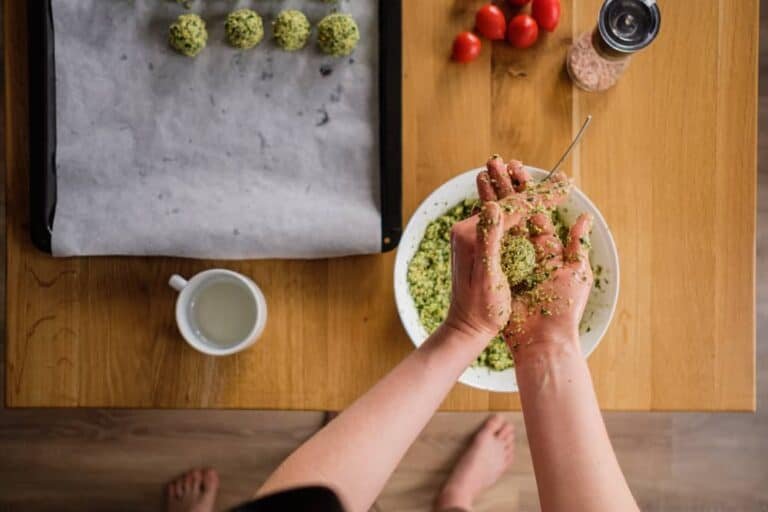
- Shape: press heaped tablespoons of the mix into small balls or patties. If they will not hold together, add a spoonful of chickpea flour.
- Fry: heat the oil to about 175°C and fry a few at a time for 3 to 4 minutes, until deep golden brown. Drain on kitchen paper.
Serve them hot in warm pitta with salad, pickles and tahini sauce, or with hummus as part of a meze. For a lighter version, brush them with oil and bake at 200°C for about 25 minutes, turning once; they will be less crisp than fried falafel but still good.
Shaping falafel before frying
Falafel around the region
Egyptian ta’amiya
Made with dried fava beans and lots of herbs, so it is bright green inside, and often rolled in sesame seeds. Eaten for breakfast with bread, salad and tahini.
Levantine falafel
In Lebanon, Syria, Palestine, Jordan and Israel, falafel is usually made with chickpeas, or chickpeas and fava beans, and served in pitta or flatbread with salad, pickles and tahini sauce.
Turkish falafel
In Turkey, falafel is newer than in the Levant and is usually made with chickpeas, garlic, coriander and cumin. It is shaped into balls or small flat patties and served with bread, salad and tahini or yoghurt sauce.
Falafel for vegetarians and vegans
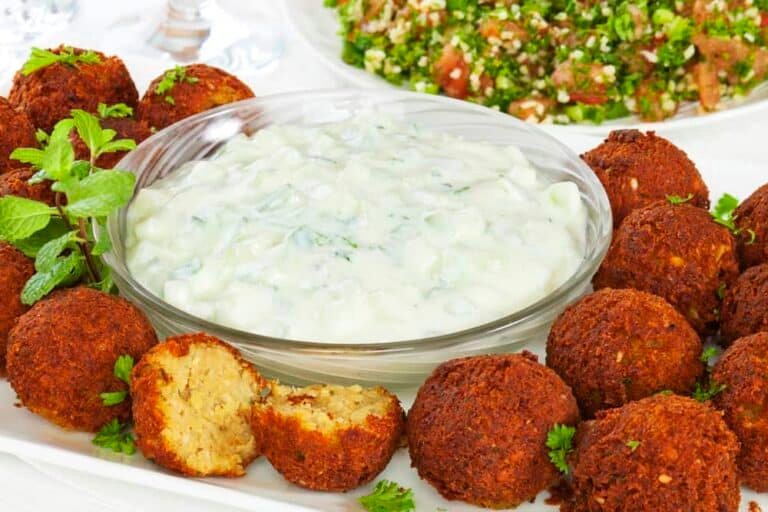
Falafel comes in many shapes and styles
Falafel contains no meat, eggs or dairy, so it is naturally vegan, and it has become a go-to choice for anyone eating plant-based, whether in a wrap, on a salad or as part of a meze.
Falafel, hummus and tahini
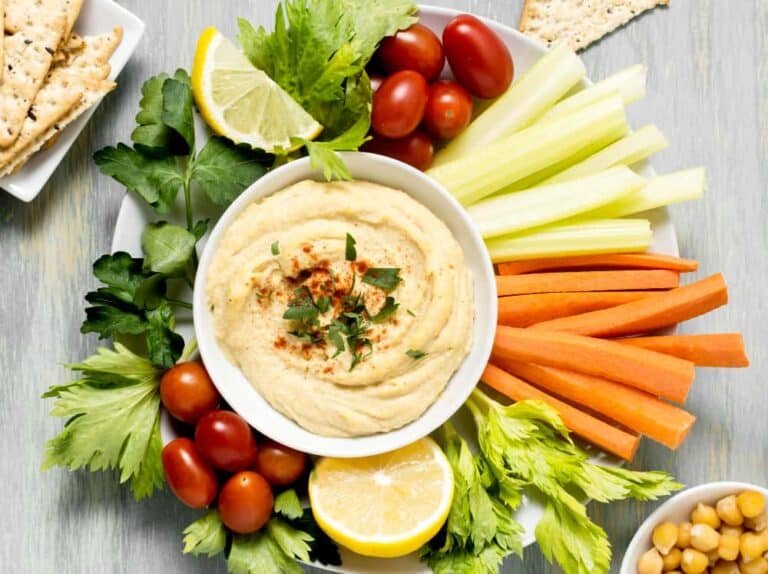
Falafel and hummus are made from the same humble chickpea, which is why they are so often served together, but they are made in opposite ways. Hummus uses chickpeas that are cooked until very soft and blended smooth; falafel uses chickpeas that are only soaked, ground coarsely and fried. Tahini, the sesame paste that goes into hummus, is also the classic sauce for falafel: thinned with lemon juice, garlic and water until it pours. Put all three in a warm pitta with tomato, cucumber and pickles and you have the classic falafel sandwich. Read more in our guide to hummus.
Falafel world records
Falafel has its own place in the record books. In May 2010, a team of around 300 cooks led by Lebanese chef Ramzi Choueiri made the largest serving of falafel ever recorded, more than 5,000 kg, in Beirut. And in 2012, chefs in Amman, Jordan, made what Guinness World Records listed as the largest single falafel ball, weighing almost 75 kg.
Chickpeas at Nosta
Falafel is not on our menu at the moment, but its chickpea cousin is: our hummus (€8.90) comes with house bread, or as part of the meze plate for two (€23.90). Eating vegetarian? Vegetarian dishes are marked V on the dinner menu.
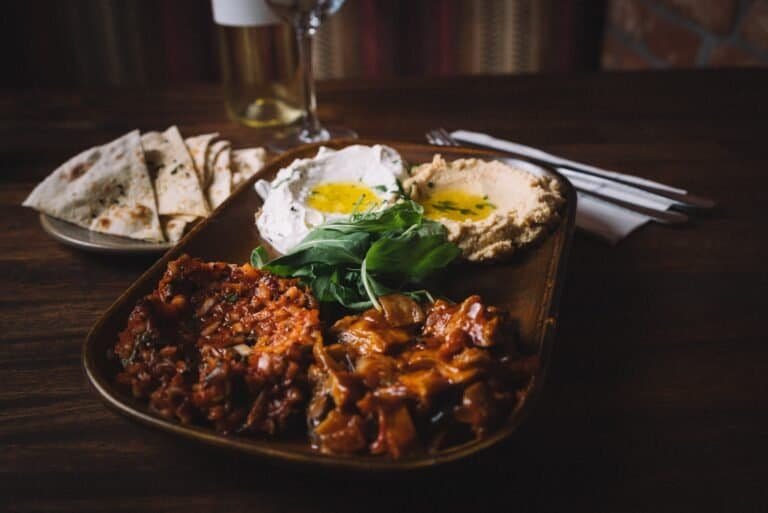
Hummus, tzatziki, ezme and aubergine salad on the meze plate at Nosta
Love falafel? Try the meze plate
At Nosta
Hummus, tzatziki, ezme and aubergine salad with house bread, to share. See the
meze on our menu.
Questions people ask
What exactly is falafel?
Deep-fried balls or patties of ground, soaked chickpeas or fava beans, mixed with onion, garlic, fresh herbs and spices such as cumin and coriander.
What does falafel taste like?
Crisp and golden outside, soft and green with herbs inside. It tastes earthy and nutty from the chickpeas, fresh from the herbs and warm from the cumin.
Where does falafel come from?
Most food historians trace it to Egypt, where it is called ta’amiya and made with fava beans. The chickpea version spread through the Levant, in Lebanon, Syria, Palestine, Israel and Jordan, and from there around the world.
What do you eat falafel with?
Warm pitta or flatbread, salad, pickles and tahini sauce are the classics. It is also good with hummus, tabbouleh, yoghurt sauce or on a salad bowl.
Is falafel vegan?
Yes. Traditional falafel is made from chickpeas or fava beans, herbs, spices and oil, with no meat, eggs or dairy. Check the sauce: tahini is vegan, yoghurt sauces are not.
Can you eat falafel cold?
Yes. Cooked falafel can be eaten cold, in a wrap or a salad, as long as it has been kept in the fridge. Hot is best, though, straight from the fryer. To crisp leftovers up again, warm them in a hot oven for 5 to 10 minutes; the microwave makes them soft.
Does falafel make you gassy?
It can. Chickpeas and fava beans contain oligosaccharides, sugars our gut cannot fully digest, so bacteria ferment them and make gas. Soaking dried chickpeas overnight and throwing the water away helps, and so does eating a smaller portion with plenty of salad.
Can you reheat falafel?
Yes. Reheat it in the oven at about 180°C for 8 to 10 minutes, or in an air fryer for about 5, until piping hot all the way through. The microwave works but leaves the outside soft.
How does falafel stay crispy?
Use dried, soaked chickpeas rather than cooked ones, dry them well, keep the mixture cold, fry in oil that is hot enough (about 175°C) and drain on kitchen paper.
Is falafel healthy?
Falafel is a good source of plant protein and fibre, but deep-frying adds fat. Baked falafel, or a smaller portion with plenty of salad, is the lighter option.
Is falafel gluten-free?
The falafel itself usually is, if made only with chickpeas or fava beans; some recipes add flour or breadcrumbs. Pitta bread is not gluten-free.
Does falafel contain nuts or dairy?
Traditional falafel has neither: it is chickpeas or fava beans, herbs, spices and oil. Tahini sauce is made from sesame, a common allergen, and yoghurt sauces contain dairy, so check what it is served with.
Is falafel Turkish or Greek?
Neither, originally. Falafel comes from Egypt and the Levant. You will find it in Turkey and Greece today, but it is not a traditional dish of either kitchen.